

Assessing State Fragility
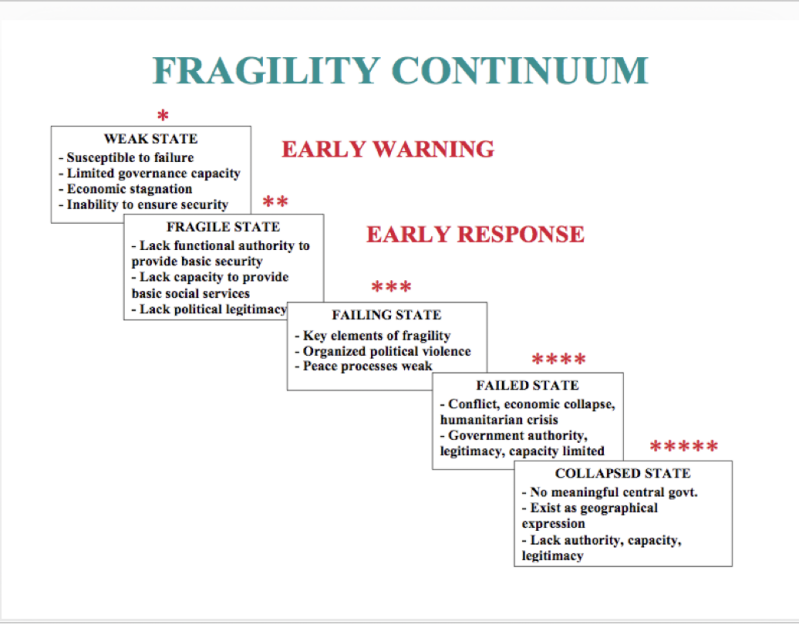
The Fund for Peace argues that "in a highly interconnected world, pressures on one fragile state can have serious repercussions not only for that state and its people, but also for its neighbours and other states halfway across the globe." Carleton University in Ottawa defines the terminology of state failure as countries decline on a continuum from WEAK to COLLAPSED.
It is no coincidence that the poorest of the poor, the intended recipients of development assistance programmes, commonly reside in countries affected by conflict; countries that are also poorly-governed. They house hundreds of millions of people who live on less than $1 per day, and have the highest infant and maternal mortality rates.
Good work has been done on the causes of state fragility that would enable ‘drivers of stability’ to be developed to counter conflict. These causes range from the failure of economic and inclusive growth, to inability to perform state functions, to exclusionary practices, arbitrary governance and difficulties that stem from external and regional factors. Conflict and fragility can stem from one or a number of these causes, and evolve over time. Whether the indicators of state fragility were documented years ago or recently, you will notice that they have identified similar risks.
Amongst development actors, there is a consensus on the need for conflict prevention, peace-building and state-building efforts in fragile states. There are humanitarian, ethical and economic reason to engage. The challenge is in mobilising the political will to act.
Country Risk Assessment Tools
Fragile States Index - Fund for Peace
Freedom in the World - Freedom House
Additional Tools
Freedom House - Risk Indicators
Fund for Peace - Risk Indicators of Fragile States
Netherlands Institute of International Relations - Stability Assessment Framework
Consolidated Risk Factors of Violent Conflict

World Bank - Conflict Analysis Indicators